
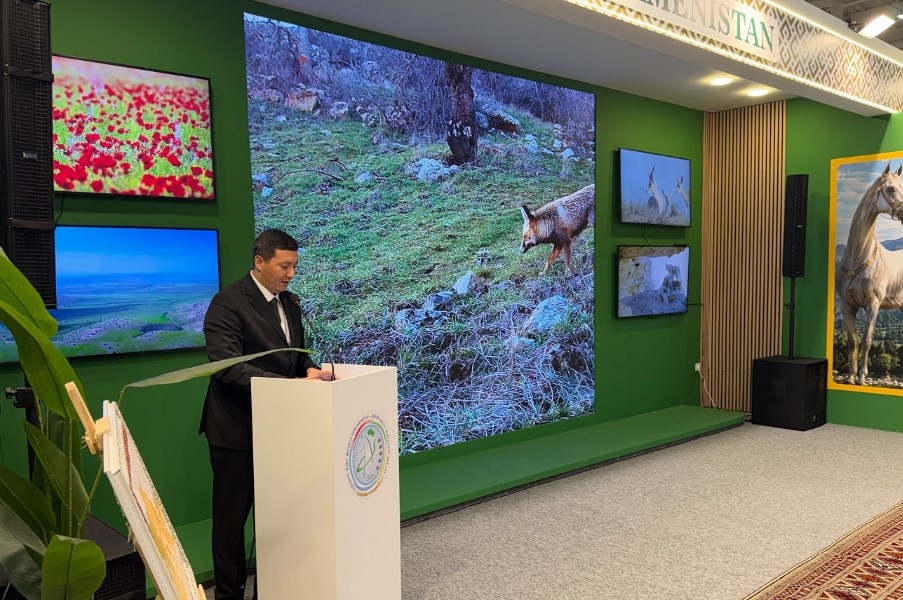
Bilim ulgamy howa başlangyçlary boýunça bäş teklibi öňe sürdi
A child who starts kindergarten in Turkmenistan this year will enter the workforce around 2040. The people who will be responsible for fulfilling the climate commitments being adopted today are currently sitting at school desks.
Adults are often alarmed by images of an impending climate catastrophe and urged to accelerate a “green revolution”, with its progress measured in megawatts and tonnes. Turkmenistan, however, is placing its emphasis elsewhere: on gradually transforming people's attitudes towards nature through small but highly significant steps, beginning with the development of environmental awareness in young children. A solar panel can be installed in just a few days, but the habit of conserving water, reading climate data and feeling personally responsible cannot be established “with a single click”. It takes years to develop.
For Turkmenistan, as for its Central Asian neighbours, climate change is not merely a matter of energy and water balances, which are so often debated at international forums. It is also a school of moral and spiritual values. This leads to a fundamental principle: green thinking must not be confined to a separate extracurricular activity or a one-off campaign; instead, it must run like a continuous thread throughout the entire education system.

These ideas were particularly clearly articulated at the UN Climate Conference COP-31 in Antalya, where Central Asian countries presented themselves not merely as a geographical region, but as a united front in the face of environmental challenges.
The Central Asian states brought to the summit a common agenda encompassing transboundary water sustainability, initiatives to assess climate-related losses and damage, as well as projects aimed at technological integration and the harmonisation of environmental standards in industry.
Against this broad international backdrop, Turkmenistan presented a clear position by establishing its own National Pavilion in the “Blue Zone”. The pavilion became a focal point for discussions on the future of developing countries, including landlocked states.
At COP-31, the Turkmen delegation focused on the strategic priorities previously outlined by Gurbanguly Berdimuhamedov, Chairman of the Halk Maslahaty of Turkmenistan. The national strategy is based on a profound understanding that environmental security in Central Asia is indivisible: transboundary rivers, melting glaciers and shared airspace recognise no administrative borders.

During the forum, Turkmenistan presented an initiative to establish a Regional Centre for Climate Technologies for Central Asia, intended to serve as a technological hub for the entire macro-region.
At the same time, Ashgabat placed strong emphasis on the humanitarian dimension from the outset. This reflects the understanding that regional innovations, the transfer of specialised technologies and projects aimed at adapting to drought or land degradation will remain merely on paper unless the next generation of engineers, agronomists and managers on both sides of national borders possesses systematic environmental literacy.
Thus, technological cooperation among Central Asian countries has found its logical continuation in the development of a unified educational framework. This idea is fully consistent with the spirit of the Awaza Programme of Action for Landlocked Developing Countries, reminding the international community that geographical isolation from the oceans can be overcome through strong internal connections and the development of human capital.

During COP-31, the Turkmen delegation actively participated in a wide range of the summit's discussion sessions. However, in our view, the fifth thematic session, entitled “Civil Society Organisations and Climate Solutions: From Local Initiatives to Global Action”, became the highlight of the humanitarian agenda.
It was here, at the intersection of civil society and public policy, that Azat Ataev, Deputy Minister of Education of Turkmenistan, delivered a keynote address.
As the Deputy Minister noted, a transformation in people's awareness takes place gradually, step by step. First, a person develops a sense of care and concern; then comes understanding, followed by practical experience. Subsequently, through conscious action, the individual acquires professional skills and masters a profession. As the speaker emphasised, each stage of this educational process in the country is assigned a specific objective: the development of environmental culture.
In Turkmenistan, the first step — developing a sense of care — begins in kindergarten. Starting from the 2025–2026 academic year, new programmes and teaching materials on climate change adaptation and disaster risk reduction, developed jointly with UNICEF, have been introduced. Through play-based learning, children are taught to develop a sincere respect for nature.
The next stage, known as understanding, takes shape at school, where climate-related topics are integrated into existing subjects, bringing together nature, economics and technology. To support this process, thousands of methodological teaching materials have been distributed throughout Turkmenistan in cooperation with international partners, and the educational package known as the “Climate Box” has been introduced.
The next step — practical application — begins with the “Green School” initiative, where the entire educational institution becomes a classroom. Launched as a pilot programme, it already covers 120 schools in Turkmenistan, with the ambition of increasing this number to 500 by 2030. A real-life example is Secondary School No. 36 in the city of Mary, where data from a solar power station is used directly during practical lessons.
In his address at the fifth session, Deputy Minister of Education Azat Ataev emphasised that at the stage of conscious action, young people in Turkmenistan are actively demonstrating their commitment through projects submitted to the “Green Skills” competition, the preparation of the National Youth Statement for COP-31 for submission to the YOUNGO constituency, and the direct participation of young delegates in the Turkmenistan Pavilion.
The speaker also drew attention to the fact that, in the professional sphere, environmental awareness becomes a fully-fledged career. In particular, Turkmenistan has 18 technical colleges where an environmental studies course is compulsory. Universities specialising in relevant fields teach renewable energy and energy management. A Hydrogen Energy Centre has been established, while the “Atlas of Future Professions” identifies 13 green occupations expected to be in demand. The UNESCO Chair in Environmental Education and new programmes for training trainers ensure continuity in this work for teachers.
According to Azat Ataev, this strong connection is maintained because one end of the thread is anchored in the state through the Paris Agreement, legislation on renewable energy sources and national strategies, while the other is connected to the real economy and employers' needs. These needs shape the government order for qualified personnel within the framework of a roadmap being developed in cooperation with the Asian Development Bank.
Furthermore, the large-scale initiatives proposed on 11 November by Gurbanguly Berdimuhamedov, Chairman of the Halk Maslahaty, find direct expression in the education sector and provide further momentum to the regional agenda. For example, the Decade of Climate Resilience proposes safe schools and education for every child; the Digital Atlas envisages the transfer of observations collected by schools; the Regional Technology Centre initiative involves creating a network of Central Asian universities as a unified educational platform and a foundation for applied research; and the International Environmental Code initiative calls for climate literacy to be promoted everywhere.
On 11 November in Antalya, Jumamyrat Gurbangeldiyev, Minister of Education of Turkmenistan, signed the Declaration on Children, Youth and Climate Action. The declaration reaffirmed the commitment to providing opportunities and a platform for the younger generation by bringing together efforts within the framework of the Central Asian States Youth Dialogue and the forthcoming Ashgabat Climate Dialogue.
Against this background, it is becoming increasingly clear where the climate discussion in Turkmenistan and Central Asia is heading: from general statements to concrete mechanisms, and from seeking funding and establishing technological centres to painstaking, long-term work with people. While the world debates tonnes of emissions from industrial zones, an important reminder is being made here: no technological hub and no transboundary agreement can work effectively without well-prepared people and a genuine, conscious attitude towards the environment.
Climate policy sets the objectives, education prepares the people who will achieve them, and the genuine green transition always begins in the human mind — a space that no geographical border can restrict.
This is precisely the foundation of the work being carried out in Turkmenistan with those who have started kindergarten, continued their education at school or entered higher education institutions this year. After all, it is these young people who will fulfil the climate commitments being undertaken by adults today, not only in the near future but also over the long term.